


Híreink
Med-Econ
The faces behind Med-Econ – Csaba László Dózsa, habil PhD, MSc, founder and senior health economist.
Thirty years in Hungarian healthcare, seen from every side – as regulator, policymaker, and market expert.
He spent eleven years at the National Health Insurance Fund (NEAK / OEP), rising to Deputy Director-General for Healthcare, then served as Deputy State Secretary at the Ministry of Health – before founding Med-Econ in 2006. He also co-founded the Hungarian Health Economics Association (META) in 2003 and served as its president across several terms.
His work is anchored in research: Associate Professor at the University of Miskolc, with a PhD from Corvinus University (2011) and a habilitation in health sciences from the University of Pécs (2022). A speaker at dozens of conferences and professional events, he works in Hungarian, English, and Spanish.
Away from the numbers, he recharges through sport and time in nature.
At Med-Econ, three decades of system knowledge meet one discipline – decisions built on evidence, not guesswork.
Med-Econ · med-econ.eu
Tovább olvasom
Megnyitás LinkedInen ↗
Dr. habil. Dózsa Csaba
A health budget can grow by 167 billion forints and still leave the two largest patient care budgets exactly where they were.
Family medicine stays at 296.5 billion. Inpatient specialist care stays at 762.6 billion. Outpatient care stays at 221.1 billion. The fund financed ambulance line stays at 45.8 billion.
I went through the bill's health lines for Népszava.
The fund itself does grow, from 4,945 billion to 5,112 billion, so 167 billion nominal.
Most of it went to medicines, and even that is smaller than it looks. High cost pharmaceuticals rise by 48.3 billion against this year's original plan, but last year's actual spending on that line was already 240 billion. Against last year the increase is about 3 billion. Drug subsidy rises by roughly 40 billion.
New therapies are not waste and I would defend those lines. They are also not where a director finds the room to operate on a Saturday.
The pledge was at least 500 billion forints more every year than the year before, until public health spending reaches 7 percent of GDP in 2030. About half a percentage point of GDP a year.
But only on top, and the fund is not even standing still. The 4,902 billion actually spent last year was 5.63 percent of GDP. The 5,112 billion here is 5.54 percent of the GDP this budget itself forecasts. Holding last year's share would have taken 5,197 billion, so the plan lands about 85 billion short of standing still.
That is not catch-up. It is a smaller share of a bigger economy, written in bigger numbers.
I know what the fiscal picture looks like. The same bill carries a deficit target of 7.5 percent of GDP, and on the sequencing the sector can be patient. I am not asking for money that is not there.
Timing is the part I find harder. In July the nursing pay rise was being put at 20 to 25 percent, reportedly possible before the end of this year. By early September it belongs to next year's budget, with no percentage and no start date attached.
I do not read that as bad faith. I read it as a communication problem, and that one is fixable.
One more thing, and I mean it. The people holding the wards and the practices together are doing it on reserves that ran out a long time ago. Nothing above is a criticism of them. The gap between the promise and the budget is being absorbed by their working hours.
If you had to start your institution's 2027 plan this month, which number would you need published first?
Full interview in Hungarian:
https://lnkd.in/daTzv2Wj
Tovább olvasom
Megnyitás LinkedInen ↗
Dr. habil. Dózsa Csaba
You cannot recruit someone for a decade of work while the terms of the job are still unpublished. That is roughly where seventy Hungarian hospitals stand right now.
I went into this on Kossuth Rádió on 28 August, alongside Dr Péter Álmos, president of the Hungarian Medical Chamber.
Ten to fifteen hospital directors have been replaced in recent months, mostly without an open competition, and in some cases with no stated reason.
A hospital is an organisation of a thousand people, often several thousand. The person at the top decides every day about resources, about keeping the staff that cannot be replaced, about pay and conditions. That job runs on credibility, and credibility does not survive being temporary.
OKFŐ, the national hospital directorate, has signalled it wants to open these posts to competition. There is still no published deadline or procedure.
Before anyone applies, they have to be able to see what they are applying for.
When do the tariffs move? The DRG (HBCs) base rate and the outpatient forint per point set the room an institution has to plan in.
Is there development money over the next three to four years, at the scale that modernises a building stock or replaces an equipment park?
And is there a policy direction to write a programme against, digitalisation, patient safety, operational efficiency, day surgery?
A candidate can write a serious programme against those. Nobody can write one against silence.
A proper search takes six to eight months, from the call to the new director starting. That is what a job of this size costs to fill, and it cannot be a single decision by a minister or an agency head. For the biggest institutions it is search work.
Internal candidates should be able to enter, and where there is no strong one, the field should open to managers from outside healthcare too.
This was the subject of my doctoral research, and it matched what I had already seen from the payer and the regulator side. The institutions that actually develop are the ones with stable leadership across five, ten, fifteen years, with a long-term vision, a medium-term strategy and the discipline to implement week by week. That only pays off where the environment around them holds too, from procurement rules to training capacity.
The way I see it, the competition is the easy part. What decides whether it produces anything is whether the winner can see three years ahead on the day they sign.
If you have been through a leadership change from inside a hospital, how long did it take before anyone could plan again?
Full discussion in Hungarian:
https://lnkd.in/gpRcthzW
Tovább olvasom
Megnyitás LinkedInen ↗
Med-Econ
What is Health Technology Assessment – and why it belongs before the investment decision, not after.
HTA is the set of methods that evaluate a health technology across the dimensions that actually matter: effectiveness, efficiency, cost-effectiveness, and its wider economic and social consequences.
A full assessment weighs burden of disease, clinical trial evidence, health gain, cost-effectiveness, budget impact, and public-health need – turning scattered evidence into one defensible decision.
At Med-Econ, HTA is a core discipline, with a particular focus on new medical devices and procedures. Recent evaluations span technologies from insulin-pump systems and advanced wound care to extracorporeal blood purification.
The goal is always the same: turning clinical evidence into an economic decision that holds up.
Med-Econ · Independent health economics, HTA, and healthcare strategy
Tovább olvasom
Megnyitás LinkedInen ↗
Dr. habil. Dózsa Csaba
A pharmacist told me, between two sessions, that she now talks to oncology patients more than some of their doctors do.
That stayed with me.
I opened the Friday oncology day at the XXXV. National Congress of Pharmacists in October, the first speaker at 9am.
A clinical-pharmacy room, and there I was, the health economist, talking about something that sounds like the soft part of care: patient-pathway organisation and patient education.
It is not the soft part. It is the part that decides whether an expensive therapy actually works.
What struck me most was not on any slide.
It was the moment I realised how much one oncology patient now depends on people sharing what they know.
The diagnostics have changed.
The oral therapies have changed.
The reimbursement rules around them have changed.
No single person holds all of that anymore.
That is the sentence I keep coming back to. This knowledge no longer fits in any one person's head. It only fits in a team.
The pharmacist sees the patient between hospital visits. The oncologist sets the therapy.
Someone has to organise the pathway so the patient does not fall through the gaps between them. By the end of the day, colleagues who had never worked together were already planning to.
The way I see it, the economics follow the teamwork, not the other way round.
If you organise care around a team, the money tends to be better spent. If you organise it around a single role, you pay for the gaps.
Curious how this looks in your own institution?
Tovább olvasom
Megnyitás LinkedInen ↗
Med-Econ
The record behind almost two decades of independent analysis:
70+ references · 80+ won grants and tenders · HUF 25 billion in awarded project funding · 230+ publications · 60+ partners across public and private healthcare.
Since 2006, Med-Econ has delivered health-economic analyses, feasibility studies, and HTA evaluations for county hospitals, universities, professional bodies, and life-science companies – from EU-funded consortium projects to single-technology reimbursement studies.
Credibility built one analysis at a time.
Source: Med-Econ project record, 2006–2024 · med-econ.eu/referenciak
Tovább olvasom
Megnyitás LinkedInen ↗
Dr. habil. Dózsa Csaba
0.25 percent. That is roughly how much of Hungary's public health budget we spend on running the system that allocates it.
The international norm sits at 3 to 4 percent.
I raised this talking at Pogi Podcast with Dr István Kósa back in march, in the "Korkép a magyar egészségügyről" series, I keep coming back to it.
Here is why the gap matters.
We move around 3,000 billion HUF of public money through NEAK every year. That figure gets a lot of attention.
What gets almost none is the cost of managing it well. Analysis, monitoring, clinical audit, the people who check whether the money actually buys health.
When you spend a quarter of a percent on that function, there is simply nobody to optimise the other 99.75 percent.
I have seen this from inside. Eleven years at NEAK, then on the regulator side, and twenty years since as an outside analyst.
The pattern is the same everywhere I look. We treat the management layer as overhead to cut, not as the thing that protects the spend.
The result is a black box. Inside that 3,000 billion sit redundant tests, outdated procedures that newer ones replaced years ago, and process variation between regions that nobody measures.
A routine X-ray still gets billed in large volumes long after CT and MRI made it unnecessary. We have no regular mechanism to retire what no longer earns its place.
The way I see it, raising system management toward 2.5 to 3 percent is not bureaucracy. It is the precondition for every other reform working.
You cannot manage what you do not measure. And right now we barely fund the measuring.
Curious how this looks against your own institution's data? Happy to share the underlying analysis.
Full podcast in hungarian: https://lnkd.in/dwAMzdbt
Tovább olvasom
Megnyitás LinkedInen ↗
Med-Econ
Innovative solutions for today and tomorrow.
That principle has guided Med-Econ since 2006. Its mission: to drive advancements in health insurance systems and healthcare delivery through cutting-edge research and strategic development.
For 20+ years, Med-Econ has helped Hungarian healthcare organisations, investors, and life-science companies make rational, evidence-based decisions – working where financing, regulation, and advisory expertise meet. Not from the clinical or manufacturing side, but from the economic-analytical one: reading the numbers, and drawing conclusions from them.
Almost two decades. 60+ partners. One mission – advancing healthcare through evidence.
Med-Econ Kft. · Budapest · med-econ.eu
Tovább olvasom
Megnyitás LinkedInen ↗
Dr. habil. Dózsa Csaba
35,000 people are waiting more than 60 days for surgery. But the real figure is 25–30% higher.
That's the challenge I broke down recently on ATV Magyarország.
Because the hardest question isn't how to operate more, it's who we even keep a waiting list for.
Cutting waiting lists isn't a financing problem. It's systems design.
Ten questions any serious healthcare programme has to answer:
1️⃣ What should we even keep a waiting list for? Is the defined scope right? The bottleneck is often not the surgery but the diagnostics leading up to it. It's a set-theory problem: the sets overlap.
2️⃣ Do the people on the list truly belong there? False positives, less-invasive alternatives, and supply-induced demand: where there's capacity and a doctor, that's where the patients appear.
3️⃣ Who belongs on the list but isn't? False negatives, unmet need: patients never reach a diagnosis. No GP, no work-up, living far from the centre. This is a question of equity, access and equal opportunity.
4️⃣ Capacity mapping + bottleneck analysis.
(a) HR: surgeons, anaesthesiology, scrub nurses, porters, post-op recovery & nursing.
(b) Capacity: operating theatres, ICU & recovery beds, equipment, patient-pathway design.
5️⃣ Are these really the interventions we need? The list must be validated against clinical protocols, guidelines, evidence-based medicine (EBM) and health technology assessment (HTA, cost-effectiveness), and patient safety.
6️⃣ If not, develop the alternative therapeutic pathways. Rehabilitation, home care, pharmacological therapy, interventional radiology, and the care pathway leading to them.
7️⃣ Separate the time horizons. Immediate (3–4 months), short term (through end-2027), medium term. Each with its own task list.
8️⃣ Immediate action: review financing. Do the tariffs of the Hungarian DRGs (HBCs) and procedure codes, cost weights and base rates, cover actual costs? Many procedures are underfunded today; you can't make a hospital "buy" a loss.
9️⃣ Medium-term development plan. Mainly EU-funded.
(a) Expand existing centres: new tables, equipment, trained HR.
(b) Build new centres: costlier, but it levels access across the country.
🔟 Patient-pathway and referral system. A territorial institutional structure focused on the worst, longest-waiting areas.
💡 The point?
The goal isn't hitting a political promise, it's stable, equitable patient care. Funding and equipment can be created fast. The health workforce cannot. That's the real bottleneck.
Full interview in hungarian available here:
https://lnkd.in/dBFmCyW8
Tovább olvasom
Megnyitás LinkedInen ↗
Dr. habil. Dózsa Csaba
I was part of a Válasz Extra conversation with Dr Zsolt Hegedűs, hosted by Anita Élő, in collaboration with the Hungarian Medical Chamber - back in 2025.
A year on, Zsolt is now among the first turning those ideas into policy, so the demographics are worth looking at again.
Every talk I give, I open with the age pyramid.
The Ratkó cohorts, roughly 120 to 130 thousand births a year in the early 1950s, are reaching 70 to 75 now. The surgical peak is still 5 to 8 years away.
We could see this coming 15 and 20 years ago. The question is what we did to prepare.
Here is the uncomfortable part. Over four years, +1,000 billion HUF went into the fund. In the same window, every performance indicator moved the wrong way.
Corrected for inflation and GDP share, the real surplus was only a few hundred billion. And it arrived as a fixed sum, no performance expectation, no quality requirement.
That tells you the demographic wave was met with money, not with a plan.
When I was on the payer side, the whole job was holding back a profession that wanted to operate more, because public money was short. Now the money is less of the constraint. The staff is. You cannot conjure a surgical team overnight.
There is a quality piece too. Years ago we built an indicator system at the insurer. Caesarean rates, 30-day heart attack mortality, the things that hold up a mirror. It was dismantled in 2006.
Look at Sweden. They simply published heart attack mortality per hospital. Within six months the worst quartile had pulled up to the national average. Transparency alone did that.
The way I see it, the wave is not a surprise. The lack of preparation is the choice.
If you have seen the same dynamic in your own data, I would be interested to compare notes.
See the full 1 hour podcast in hungarian.
https://lnkd.in/d-VwSMCj
Tovább olvasom
Megnyitás LinkedInen ↗
Med-Econ
Hírek
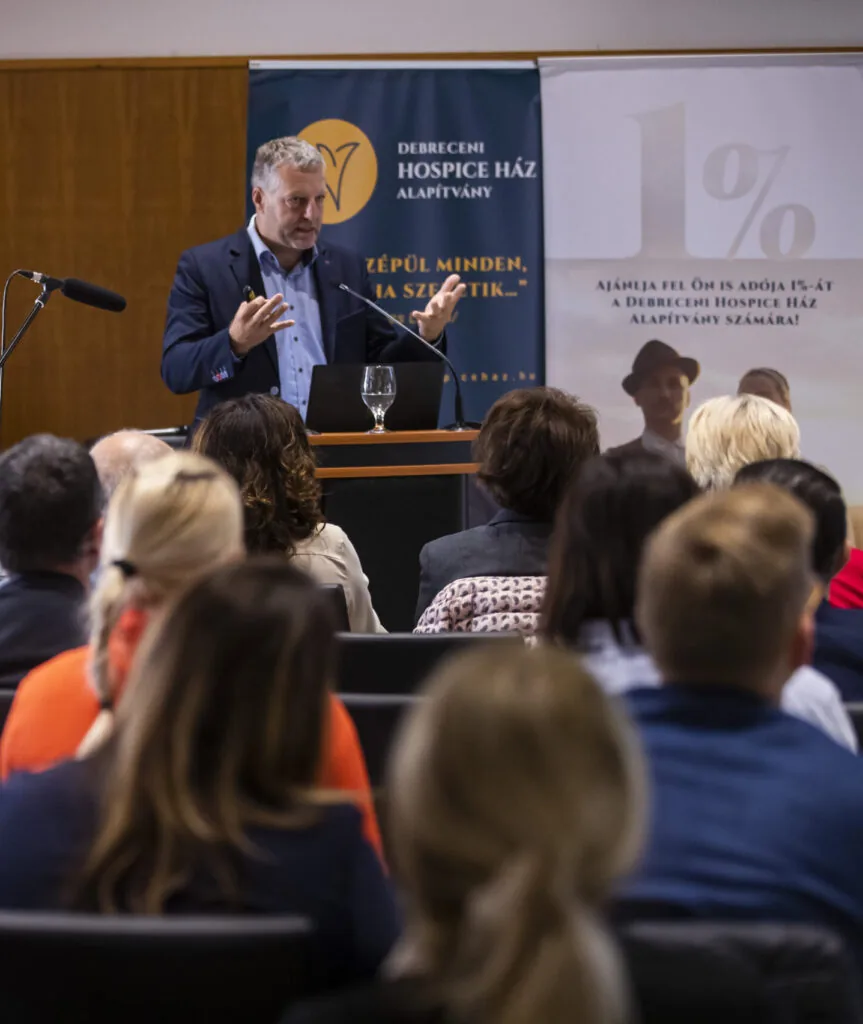
Reimagining Pharmacy Services for 2030 – Gyógyszertár 2030 ConferenceWe were proud to see Dr. Csaba Dózsa, one of Med-Econ’s lead health economics experts, join a distinguished panel of professionals to discuss the future of pharmacy-led healthcare in Hungary. Budapest Marriott Hotel, May 7, 2025.
Med-Econ
Hírek
Spotlight on Healthcare Policy & Pharmacy – XXX. National Conference of Private PharmacistsWe were proud to represent Med-Econ Ltd. at one of the key annual events for pharmacy professionals and healthcare leaders in Hungary. March 7–9, 2025, Balatonfüred.
Gyakori kérdések
Mivel foglalkozik pontosan a Med-Econ?
A Med-Econ független egészség-gazdaságtani kutató és tanácsadó cég. Fő területeink: egészség-gazdaságtani elemzések, egészségügyi technológiaértékelés (HTA), projektmenedzsment és üzleti tervezés, pályázatok előkészítése és menedzselése, valamint az egészségbiztosítási piac elemzése.
Kiknek dolgoznak?
Kórházaknak és fenntartóiknak, orvostechnikai és gyógyszeripari cégeknek, biztosítóknak, önkormányzatoknak, praxisközösségeknek és szakmai szervezeteknek. Referenciáink között szerepel többek között a Roche, a Johnson & Johnson, a Pfizer, a Generali és az Union Biztosító.
Mi az a HTA (egészségügyi technológiaértékelés)?
A HTA az egészségügyi technológiák (például új orvosi eszközök és eljárások) módszeres értékelése eredményesség, költséghatékonyság és költségvetési hatás szempontjából. A társadalombiztosítási befogadási kérelmek szakmai alapja.
Hogyan indul egy közös munka?
Egy ingyenes konzultációval: megismerjük a feladatot, majd pontos szakmai ajánlatot és ütemtervet adunk. Ezután adatalapú elemzés, munkaközi egyeztetések és érthető, döntéstámogató átadás következik.
Pályázatokban is tudnak segíteni?
Igen, a pályázatfigyeléstől az előkészítésen át a megvalósítás szakmai és projektmenedzsment-feladataiig. Eddig 80+ pályázatban működtünk közre, 25 milliárd forintot meghaladó elnyert összeggel.
Mennyi idő alatt készül el egy elemzés?
A feladat terjedelmétől függ: az ajánlatban minden esetben konkrét, reális ütemtervet adunk, és a vállalt határidőket tartjuk.